Transparency should be an obvious part of AI use. It’s only fair that companies make it evident to a user that they’re dealing with AI or AI-generated content.
This is what Article 50 of the EU AI Act imposes.
Companies are now, since Aug. 2, 2026, obliged to make it obvious when someone is talking to an AI system, or consuming content that AI made or changed.
If your team uses chatbots, generates images, or writes with AI, these rules likely touch your work. Here’s what that means.
The basics: what, when, and who
Who is affected? Two groups:
- Providers build AI systems and place them on the EU market, including companies outside the EU whose AI output is used here.
- Deployers are businesses and organizations that use AI systems in a professional setting.
Who is exempt? People using AI for purely personal, non-professional purposes, such as a personal social media post or a hobby project outside any company context.
Plus, providers of generative AI systems already on the market before Aug. 2, 2026, have until Dec. 2, 2026, to add machine-readable marking, under the Digital Omnibus on AI.
The four transparency obligations
Article 50 sets out four obligations. The first two fall on providers, the last two on deployers.
1. Interactive AI systems (providers)
If people interact with your AI system, they must be told clearly that it’s an AI, at their first interaction. Think customer service chatbots and virtual assistants. The only exception is when it’s already obvious from the context.
2. Marking and detection (providers)
Synthetic images, audio, video, and text must carry machine-readable marks so they can be detected as AI-generated. In practice, this means embedding watermarks or metadata such as C2PA in AI outputs.
3. Emotion recognition and biometric categorization (deployers)
If you use systems that recognize emotions or sort people by biometric traits, you must inform the people exposed to them. An example is facial-analysis software that estimates age or demographics in a public area.
4. Deep fakes and public-interest text (deployers)
You must clearly label AI-generated deep fakes, and AI-generated text published to inform the public on matters of public interest. Examples include AI-generated video B-roll and unedited AI news summaries. For evidently artistic, satirical, or fictional work, a lighter disclosure applies that doesn’t spoil enjoyment of the work.
In every case, the information must be clear, distinguishable, and accessible, and given at the latest at the first interaction or exposure.
When do you need to label content?
Two questions decide most cases: does the content look real, and has a human taken responsibility for it?
Deep fakes. Any AI-generated or manipulated image, video, or audio that resembles real people, places, or events, and could pass as authentic, must be labeled.
Text publications. AI-generated text published to inform the public on matters of public interest needs a disclosure. The exception: A person has reviewed it, and someone holds editorial responsibility for the publication.
| Format | Label needed | No label needed | What matters |
|---|---|---|---|
| AI chat | The user must be clearly told they’re talking to an AI, from the first interaction | Only when it’s obvious from the context | Clear disclosure |
| Text | Public-interest text with no human review | A person checks it and takes editorial responsibility | Is a human involved? |
| Image | Looks real and could mislead | Can’t be mistaken for a real person, place, or event | Impression of authenticity |
| Video | Looks real and could mislead | Can’t be mistaken for a real person, place, or event | Impression of authenticity |
What counts as a matter of public interest?
The Commission’s guidelines on Article 50 note that public interest is dynamic: it evolves over time and across contexts. Typical topics include:
- Politics and democratic processes
- Public administration and services
- Justice and law enforcement
- Protection of fundamental rights
- Public security and public health
- Environmental protection and consumer safety
- Economic, financial, political, scientific, or cultural developments under public debate
Labeling with the EU icons
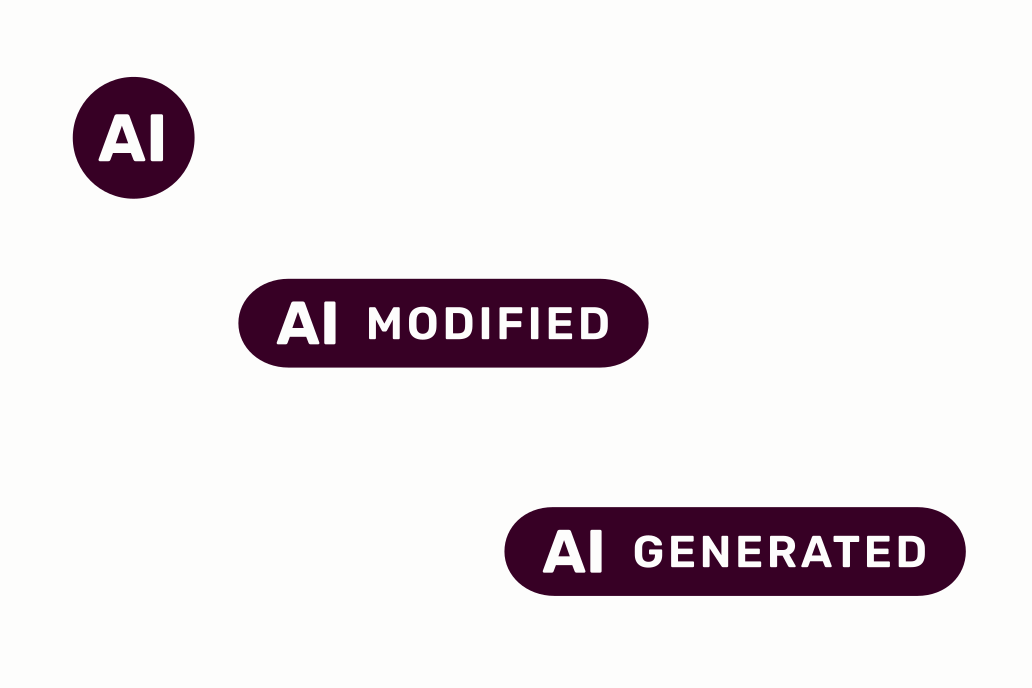
To keep disclosures clean and readable, deployers can use the free set of EU icons published with the Code of Practice on transparency of AI-generated content. The Code is voluntary, but it is one way to show you comply with the legal obligations. Choose the label by how much AI was involved:
| Label | When to use it | Example |
|---|---|---|
| Basic AI icon | AI assisted in creating or modifying the content | AI-assisted photography, graphic tweaks |
| Fully AI-generated | The output was created entirely by AI, with no human elements | Fully synthetic video clips or images |
| Partially AI-modified | Human-made content was partly altered with AI | A real photo with a swapped background or face |
Our recommendation: be proactive in disclosure
Even when the law doesn’t strictly require it, labeling content with the EU icons or a short line like “Visualized with AI” keeps trust intact without cluttering your work. When in doubt, ask your colleagues or your manager, or simply add the label.
Want to dig deeper?
- Regulation (EU) 2024/1689, the AI Act on EUR-Lex (Article 50 covers transparency)
- Guidelines on transparency obligations for providers and deployers of AI systems, European Commission, July 20, 2026
- FAQ: Transparency obligations under Article 50 of the AI Act
- Code of Practice on transparency of AI-generated content, with the EU labeling icons
- Regulation (EU) 2026/1744, the Digital Omnibus on AI on EUR-Lex
This article provides a general summary of transparency obligations under Article 50 of the EU AI Act, for informational purposes only. It does not constitute legal advice.