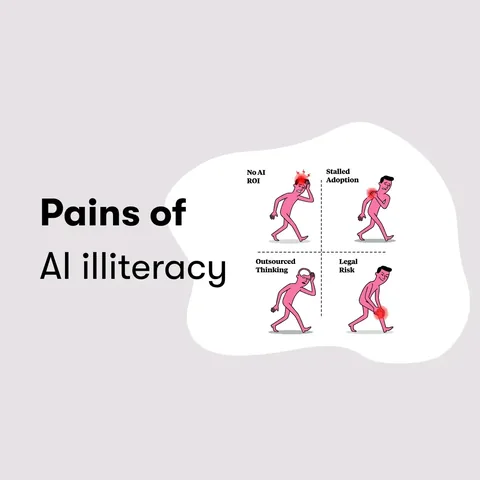
There’s a question most organizations skip when they start with AI: do your people actually understand what they’re working with — or just how to use what you’ve bought? The two aren’t the same, and the gap between them is where most AI investments quietly go wrong.

A conversation we keep having with clients goes something like this: “We have everyone on Microsoft 365 already, so we’ll just roll out the Copilot training.” And I get it — it’s practical, it’s already paid for, it’s right there.
But it’s not AI literacy. And the difference matters more than most organizations realize.
What vendor training is actually optimizing for
Here’s the thing about vendor-led AI training: the company behind it has a goal, and that goal is usage. More prompts, more sessions, more engagement with the tool. That’s how they grow. What tends to get left out is critical thinking: where does this output actually come from? When should I not trust it? Should I really be connecting my mail and calendar to this system?
That’s not a criticism of the tools. It’s just a different agenda from yours.
Tool-specific training has a real place. Your teams should absolutely know how to use what you’ve bought. But that’s the how. It shouldn’t be the thing that teaches people whether to trust an AI output, why a model behaves the way it does, or when using AI might create more risk than it solves.
A driver’s license, not a brand preference
Think of it like a driver’s license. You don’t earn one by learning to get the most out of a Tesla Model X. You earn it by understanding safe and economical driving, traffic rules — and when not to drive at all. The brand of car is almost beside the point.
Foundational AI literacy works the same way. It teaches people what they’re actually working with, how to evaluate outputs, and where the real risks lie. None of that depends on which tool you’re using, because they’re all built on essentially the same underlying technology.
The part of AI training that doesn’t go out of date
What’s also worth noting is how stable these foundations are. When Elements of AI launched in 2018, it covered the concepts that still form the building blocks of modern AI: machine learning, neural networks, probability and classification. In eight years, the course content has needed only a couple of updates. The tree keeps growing new branches, but the roots go deep.
The tools themselves, meanwhile, change almost monthly. Training your teams only on the current version of a specific product means running to stand still.
The organizations that see real returns from AI have usually done both things: they’ve built foundational literacy across the workforce, and then layered tool-specific skills on top. The foundation doesn’t replace the tool training. It makes it stick.
We talk about this every week at our free webinar — what AI literacy actually means, and how to build it across an organization. Easy to join at our website.