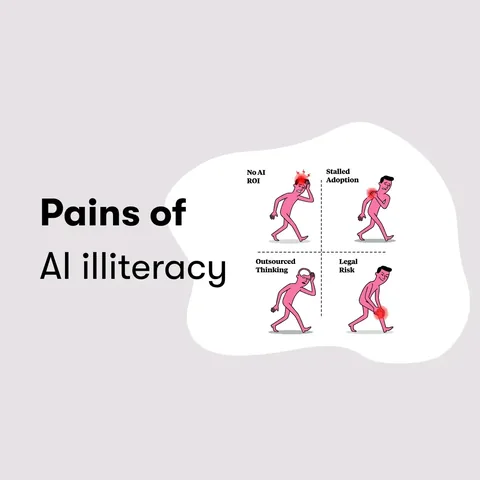
In a recent piece, Sampo argued that the ROI problem in AI isn’t a tools problem — it’s a capability problem. The fix is real AI literacy: people who can think critically, evaluate what’s worth going after, and develop the mindset for genuine change. That’s the foundation everything else gets built on. But for successful AI adoption in the workplace, the question shifts: what does leadership need to do to make it generate real results? The key players: your AI policy and managers.

In my experience coaching organizations through this, the answer almost always runs through the same place: middle management. When managers are genuinely on board — equipped, active, leading by example — the rest follows. When they’re not, no amount of training or executive ambition closes the gap.
Three things consistently show up in the organizations where it’s actually working.
Give people the right tools and rules
People need tools that actually fit their work. They also need simple rules on what data they can use, which tools are approved, and when human review is needed.
In many organizations, this decision gets left entirely to IT. The result is usually one approved platform, chosen for security reasons, with a policy that says everything else is off-limits. In practice, people use other tools anyway. On personal accounts, without telling anyone. That creates exactly the data security risk the policy was trying to avoid.
When managers are involved in the decision, it goes differently. They know what their teams actually use and what fits different roles. The tool selection becomes more practical, and the policy gets built around real examples: this kind of content is fine to put in a public tool; this kind is not. That level of clarity is what makes a policy people can actually follow.
Managers need to use AI, too
If managers do not use AI, teams will not take it seriously. Managers need to show examples, create small habits, and make AI part of normal team routines.
This means sharing what they tried in team meetings. It means raising AI use in performance conversations. It means being visible about both what works and what does not. When managers do this, adoption stops being a project and becomes part of how the team works.
Change the way work is done
AI creates value when teams redesign recurring tasks, not when they just add AI on top of old processes. AI coaches or peer learning groups can help teams build useful workflows and copy what works.
In practice, this means finding the people in your team who have already figured out something useful: the person doing research in one tool, refining it in another, producing better output in less time — and making that visible to everyone else. Run a session. Let them walk through what they do. See who else can use the same approach.
Some organizations give these people a semi-official AI coach role: a recognized function, some extra time set aside, maybe a small addition to their compensation. In smaller teams it stays informal. Either way, good workflows do not spread by themselves. Someone has to make it happen. Again, middle managers are the ones who can either fill this role or find the internal AI champions within their teams.
Is AI coming at your job as a manager?
No one knows exactly where AI is going in five years. Anyone who claims otherwise hasn’t studied it closely enough. But the uncertainty doesn’t mean waiting. Some things are obviously worth doing regardless: train your people, get the right tools, write guidelines that hold up in practice, and make sure the managers driving this change are actually equipped to lead it.
Middle managers are often quietly wondering if AI is coming for their roles. My honest answer: the ones who engage now — who build fluency and grow AI-capable teams — are the ones most likely to still have a seat when the dust settles. Human skills don’t go away. Combined with AI fluency, they become the golden combination.
That’s worth investing in. Regardless of where this all ends up.
—
One practical place to start: getting your AI policy right. Download our free AI policy template — a ready-to-adapt starting point for building your AI policy.
Tommi Raitio is the founder and lead trainer at Minara and a facilitation partner at MinnaLearn. He works with senior leaders on technology adoption — specifically the part that comes after the strategy: making change stick in practice. He has advised organizations across Europe and the Gulf on AI and autonomy adoption in environments where the standard playbook doesn’t apply.