You’ve probably seen the headlines by now. PwC surveyed 4,454 CEOs across 95 countries, and 56% of them say AI hasn’t brought them any revenue gain or cost reduction. Only 12% report seeing both. And CEO confidence in revenue growth has dropped to 30%, down from 56% four years ago.
MIT found a 95% failure rate for enterprise generative AI projects (their definition: no measurable financial returns within six months). Meanwhile, 53% of investors expect positive ROI in six months or less. So the pressure is real, and the results aren’t there.
I’ve been working on AI training programs with companies around the world for over four years now. And the pattern I keep running into is almost always the same. It’s not a tools problem. It’s a capability problem.
Let me break that down.
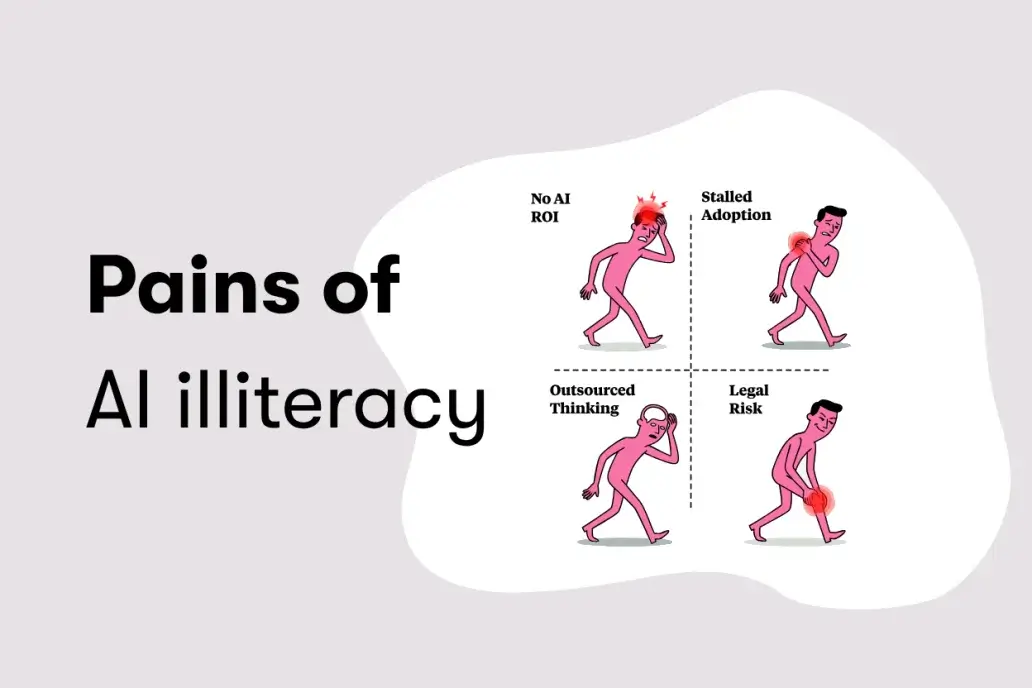
The four traps I keep seeing
No ROI, at every level
Leaders can’t tell hype from realistic opportunity. Process designers get buried under large-scale pilots that never make it to production. And frontline workers end up in what I call the “LLM casino,” just prompting and re-prompting, hoping something useful comes out.
Forbes backs this up: companies actually seeing returns are two to three times more likely to have embedded AI into real workflows, not just handed out licenses. More usage doesn’t equal more value.
Stalled adoption
Changing how people think and work requires patience. And most people right now are just overwhelmed by the constant noise around AI. They’re either afraid, skeptical, or simply don’t have the time to build new habits and processes.
The infrastructure side isn’t great either. Cisco’s AI Readiness Index found that only 32% of organizations rate their IT as fully AI-ready. Just 23% say their governance is prepared. You can’t adopt what you’re not ready for.
Outsourcing thinking to AI
This is the one that worries me most. AI companies use terms like “thinking” and “reasoning,” and your staff takes it literally, even though no such AI exists. What happens next is a shortcut: instead of applying their own expertise and directing the tool, they follow the AI’s “advice.” That’s backwards, and it’s risky.
Legal risk
Private information ends up in open systems. Copyright and IP boundaries get ignored. Teams build agentic systems that were never meant to leave the research lab. This isn’t hypothetical. It’s happening.
So what actually works?
There’s no quick fix here. No platform switch, no prompt engineering trick.
As one CIO put it, the organizations getting ROI are the ones treating AI as a transformation. They work with the business to rethink what they do and get people to work differently. That takes investing in people’s ability to think critically about AI, evaluate real use cases, and actually change how work gets done.
That’s what AI literacy is. Not a vendor tools training. It’s about building critical thinkers who can stay focused when the hype is loud, and who can develop the mindset and playbook for real change.
My plea to business leaders
Harden your business. Not with more software, but with people who can evaluate what’s real, what’s risky, and what’s worth going after. That’s the foundation everything else gets built on.
42% of CEOs say their biggest concern is whether they’re transforming fast enough. I’d say the better question is whether they’re transforming smart enough.
If you’re thinking about where to start with AI literacy in your organization, join us in our weekly webinar to discuss how to build literacy in your company.