An AI acceptable use policy only works if employees can apply it during real work. And this is what matters in governance.
Turn an AI acceptable use policy into employee habits by translating each rule into a workplace decision, practicing that decision with realistic scenarios, and checking what employees do — not just whether they acknowledge the policy. For your 2026 training plan, connect approved tools, data boundaries, output checks, and escalation routes to a measurable employee AI baseline.
TL;DR
- An AI acceptable use policy needs practiced decisions, not just employee acknowledgment.
- Teach employees to check tool approval, data permissions, and outputs before using AI-generated work.
- Use scenario assessments and workplace observations to measure policy adoption; completion alone does not prove safe use.
Five steps from policy to habit
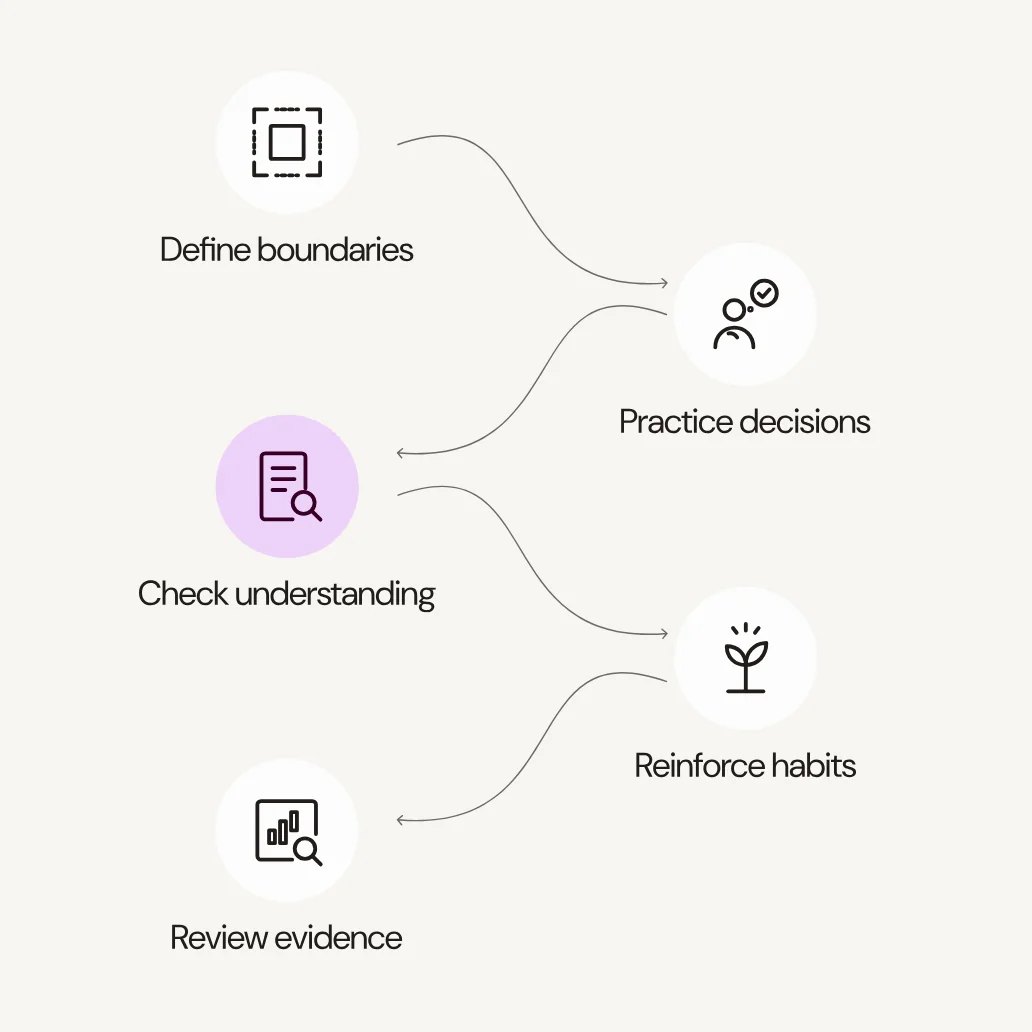
Use a repeatable sequence: define the boundaries, practice decisions, check understanding, reinforce habits, and review evidence. Give each stage an owner and a clear output. A policy document states the rules; training should show whether employees can apply them.
Define boundaries
Translate policy language into actions employees can recognize. Instead of stopping at a broad instruction to protect confidential information, explain how employees should decide whether particular information belongs in a particular tool.
Use three decisions as your starting framework:
- Tool approval: Is this tool approved for this task?
- Data permission: Is this information permitted in this tool?
- Output responsibility: What must a person check before using the result?
Document where employees find the answers. If an answer depends on the task, data classification, or recipient, make that dependency explicit rather than expecting employees to interpret legal wording themselves.
Practice decisions
Create scenarios from actual work responsibilities, with fictional or sanitized material. Ask employees to decide what they would do and explain why. The explanation reveals misunderstandings that a correct multiple-choice answer can hide.
Example: An employee wants to summarize meeting notes using an AI tool. The notes include confidential commercial information. The exercise should require the employee to check tool approval and data permissions before entering anything — not merely identify that summarization is a useful task.
Check understanding
Assess the decisions that matter, not recall of section headings. Include a permitted task, a prohibited action, and an ambiguous situation that requires help. These three scenario types distinguish knowing a rule from knowing when to stop.
Define acceptable answers before assigning the assessment. HR, IT, and the relevant policy owner should agree on the reasoning employees must demonstrate, including when escalation is the correct response.
Reinforce habits
Put reminders where decisions happen. An approved-tool directory, a short pre-use checklist, and a clear reporting route give employees something practical to consult after training.
Managers should use the same language as the policy and training. Asking whether the employee checked the source is more actionable than asking whether they used AI responsibly.
Review evidence
Keep course completion separate from demonstrated understanding. Review scenario results, recurring questions, and examples of corrected work to identify the next training need.
Record which policy version the training addressed. For a 2026 policy update, preserve the connection between the changed rule, the affected employees, and the assessment used to check understanding.
Why this matters
A signed acknowledgment records that an employee acknowledged a policy. It does not establish that the employee can recognize restricted data, question an unsupported output, or find the correct approval route.
Your 2026 rollout should therefore answer a practical question: What can employees demonstrably do after training that the policy requires? That is the connection between governance language and a measurable AI baseline.
EU AI Act Article 4 provides a supporting context for organizations within its scope. It requires providers and deployers to take measures, to their best extent, to ensure sufficient AI literacy among relevant staff and others operating AI systems on their behalf, taking their knowledge, experience, and use context into account. Training supports that work; it does not guarantee legal compliance or replace legal advice.
What should employees practice before using AI at work?
Build exercises around the decisions your policy actually requires. Do not teach a generic approval process if your company has a different one, and do not imply that removing a person’s name automatically makes information suitable for an AI tool.
| Practice area | Example workplace decision | Observable evidence |
|---|---|---|
| Tool approval | Can this tool be used for this task? | Employee finds the approved-tool guidance and follows it |
| Data handling | Can these meeting notes be entered? | Employee identifies restricted information and checks permission |
| Output checking | Can this generated summary be shared? | Employee checks claims against the source material |
| Human responsibility | Who approves the final work? | Employee follows the required review process |
| Escalation | What happens when permission is unclear? | Employee uses the designated support or approval route |
Example: A sales employee asks an AI tool to draft a proposal from approved background material. The draft includes an unsupported product claim. The training task is to identify and remove or verify the claim before sharing — not reward a polished draft simply because it reads well.
Example: An HR employee wants to use AI to organize interview notes. The exercise should test the company’s rules for candidate information and employment-related uses. Employees should not have to decide the organization’s legal position themselves.
Include a clearly permitted use as well. Training that presents only prohibited actions teaches avoidance without showing employees how to complete legitimate work within the boundaries.
Why policy adoption varies across teams
The same policy can produce different training needs. Use these factors to decide what employees practice, rather than sending everyone an identical set of examples:
- Work responsibilities: Someone drafting public copy faces different decisions from someone handling employee records.
- Information sensitivity: Exercises should reflect the data employees encounter without exposing real confidential information.
- Tool access: Employees need guidance for the tools and permissions your company actually provides.
- Existing knowledge: Assessment should identify misunderstandings before assigning additional material.
- Review responsibilities: Employees who approve others’ work need practice evaluating AI-assisted outputs.
- Policy changes: A changed rule needs an explanation of the changed action, not just a revised document.
Keep a shared baseline across these variations. Everyone should understand the company’s boundaries, while role-specific training explains how those boundaries apply to the work each team performs.
Which training approach fits your company?
Choose the approach against your policy, assessment needs, and internal capacity. Separate the content that teaches employees from the system that assigns and records learning.
| Approach | Best for | Practical advantage | Limitation or buying check |
|---|---|---|---|
| Internal training | Company-specific policy decisions | Your policy owners can teach the exact rules employees must follow | Your team must create, assess, and maintain the material |
| Courses from large learning platforms | Broad learning within an existing course catalog | A catalog can provide material for general concepts | Check whether the selected courses address your workplace decisions |
| Specialist companywide AI training | A shared employee AI literacy baseline | Focused training can organize learning around companywide needs | Check assessments, policy fit, and evidence before choosing a provider |
| Learning management system | Assigning and recording training | A delivery system organizes the learning workflow | Delivery records alone do not demonstrate employee skills |
An internal approach gives you direct control over examples and policy wording. Its trade-off is ownership: someone must keep scenarios, answer guidance, and assessments aligned when the rules change.
For catalog courses and specialist providers, inspect the actual content rather than treating the category as proof of quality. Ask employees to complete a sample task and assess whether the course prepares them to make your required decisions.
For a 2026 purchase, ask every shortlisted provider to show what an employee assessment measures, how learning relates to workplace actions, and what evidence your team can retain. Do not assume a training platform integrates with your existing systems unless the provider confirms it.
What evidence should HR, compliance, and executives receive?
Report participation, understanding, and application separately. Each answers a different question, and combining them into one success label hides the distinction.
- Participation: Who was assigned training, who completed it, and which version did they receive?
- Understanding: Which policy decisions did employees answer correctly, and where did their reasoning fail?
- Application: What do approved work reviews or scenario follow-ups show about how employees apply the rules?
Define a denominator for every completion or assessment rate you report. State whether the figure covers assigned employees, participating employees, or another clearly defined group. A percentage without that scope is not board-ready proof.
Use only evidence collected through approved processes. Do not introduce undisclosed monitoring to measure policy adoption. Agree with HR, legal, and IT on what is collected, who can access it, and how it will be used.
Your 2026 executive update should connect an identified gap to a specific response. If employees misunderstand data permissions, report that issue and the corrective exercise — not merely that another course was assigned.
How do you keep an AI acceptable use policy current?
Treat a policy change as a change in employee behavior. Identify the old instruction, the new instruction, and the tasks affected before deciding who needs updated training.
For a newly approved tool, explain permitted tasks, information restrictions, and review expectations together. Approval of a tool should not be presented as approval of every possible use.
Keep an owner for policy interpretation and an owner for training updates. These responsibilities can sit in different teams, but unresolved questions need a clear route between them.
How do you know employees understand the AI policy?
Employees demonstrate understanding when they can make the required decision and explain the reason in a relevant scenario. Test tool approval, data permission, and output responsibility rather than relying only on acknowledgment.
Use mistakes to assign focused follow-up. Someone who selects an approved tool but misses a data restriction needs a different exercise from someone who fails to verify an output.
Can training replace an AI acceptable use policy?
Training cannot replace an AI acceptable use policy because employees need an authoritative statement of the company’s rules. Training turns those rules into practice; the policy remains the reference for permissions, restrictions, and responsibilities.
Keep both aligned. A course that teaches a different approval route from the policy creates a decision problem instead of solving one.
FAQ
What’s the first step in putting an AI acceptable use policy into practice?
Translate the AI acceptable use policy into workplace decisions employees can recognize. Start with approved tools, permitted information, output checks, and the route for questions or exceptions.
Is acknowledging an AI policy enough to show employees understand it?
Acknowledgment alone does not demonstrate understanding. Use realistic scenarios that require employees to choose an action and explain their reasoning.
Should every employee receive the same AI training?
Employees need a shared baseline, with additional practice matched to their responsibilities and use context. Someone reviewing employee information needs different scenarios from someone drafting public-facing copy.
Does AI literacy training guarantee EU AI Act compliance?
AI literacy training does not guarantee EU AI Act compliance. Article 4 requires context-sensitive AI literacy measures; legal teams should assess the organization’s obligations and supporting evidence.
Can our learning management system teach employees safe AI use?
A learning management system delivers training; the selected content and assessment determine what employees learn. Check whether employees can apply your policy rather than treating delivery records as proof of skills.
One last thing
Include a scenario where asking for help is the correct answer. If every exercise rewards an immediate yes or no, you have not tested the employee’s ability to recognize uncertainty and use the escalation route.
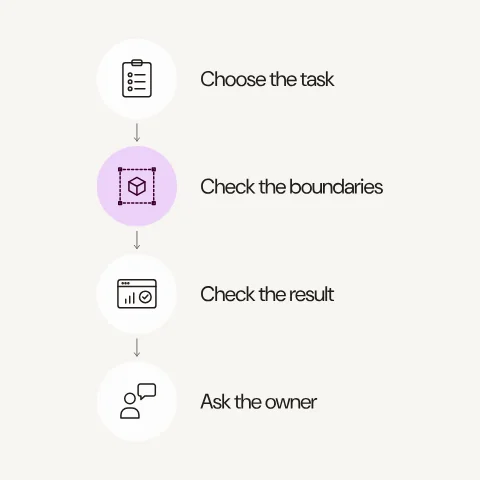
That is a concrete habit to build: stop before entering restricted information or relying on an unchecked output, find the relevant rule, and ask the designated owner when the answer remains unclear.