Finished training doesn't show that anyone works differently. Instead, find ways to measure what employees do on the job using existing frameworks.

Use the Kirkpatrick Model to evaluate whether AI literacy training carries through into employees’ work, focusing on Level 3: Behavior. Distinguish what employees learn from what they apply, then examine whether those workplace behaviors contribute to the organizational outcomes you agreed before training.
TL;DR
- The Kirkpatrick Model separates reaction, learning, behavior, and results.
- Level 3 evaluates application in the workplace, including performance support and accountability.
- AI-specific examples need local policy context; they are not standardized Kirkpatrick measures.
- Agree on intended outcomes before choosing assessments or reporting results.
Four levels of training evaluation
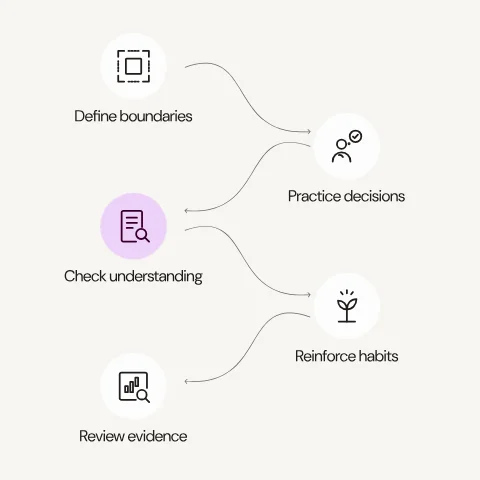
Start with an established training-evaluation framework, then define the AI-related decisions relevant to your employees. The Kirkpatrick Model provides four linked evaluation levels: Reaction, Learning, Behavior, and Results. Kirkpatrick Partners advises starting evaluation planning with Level 4: the organizational results the initiative is intended to support.
For AI literacy training, that means agreeing on the workplace outcome first, identifying the employee behaviors that support it, and deciding what employees need to learn. Evaluate whether the work environment supports those behaviors as well as whether people understand them.
The Kirkpatrick Model is a training-evaluation framework, not an AI-literacy certification standard or a universal scoring system. It does not supply a ready-made AI safety score, pass mark, or follow-up calendar. The AI examples below illustrate how an organization could apply the framework; they are not requirements published by Kirkpatrick Partners.
| Kirkpatrick level | What the framework evaluates | Illustrative AI training application | What the evidence cannot establish alone |
|---|---|---|---|
| Level 1: Reaction | Whether participants find the experience favorable, engaging, relevant, and supportive of the intended work | Employees explain whether the training addresses decisions they face in their roles | Whether they can make those decisions correctly |
| Level 2: Learning | Acquisition of intended knowledge, skills, attitude, confidence, and commitment | Employees demonstrate how they would check an AI-generated answer in an assessment | Whether they apply that check in everyday work |
| Level 3: Behavior | Performance of critical behaviors in the work environment, with support and accountability | A reviewer observes whether required checks happen during a real task | Whether training alone caused a change |
| Level 4: Results | Targeted organizational outcomes associated with the initiative and performance support | The organization reviews an existing quality measure linked to the behavior | Whether every change in the measure is attributable to training |
The level definitions come from Kirkpatrick Partners. The AI applications and limitations are explanatory examples, not a validated AI assessment instrument.
Why use the Kirkpatrick Model for this question?
The Kirkpatrick Model fits this question because it explicitly distinguishes learning from workplace behavior and organizational results. That distinction lets you assess whether employees apply AI training at work without treating a completed course or a better test score as proof of changed habits.
Three features make it useful here:
- A dedicated behavior level: Level 3 asks whether people perform the critical behaviors in their work environment, directly addressing the article’s question.
- Attention to workplace conditions: Performance support and accountability help explain why someone who understands a rule might still struggle to apply it.
- Results-first planning: Starting with the intended organizational outcome gives you a reason for selecting each behavior and measure, rather than collecting whatever the training platform reports.
These features are described in the official Kirkpatrick Partners guidance linked above. The model supplies an established evaluation structure; your organization’s tasks and policies supply the AI-specific context.
Is the Kirkpatrick Model widely used and scientifically validated?
Kirkpatrick is widely used as a training-evaluation framework, but widespread use is not the same as scientific validation. An independent Institute for Employment Studies review of training-evaluation models describes its practical strengths as simplicity and ease of understanding, alongside its widespread adoption. That supports choosing it as a familiar structure for evaluation, not treating it as an uncontested scientific standard.
The same review reports that research has not demonstrated the implied causal chain between its levels. A peer-reviewed review of its use in higher education, published in 2021, also identifies limited evidence for causal links among the levels. That review concerns higher education, not workplace AI literacy, so it should not be read as a direct validation study of AI training.
The distinction matters: employees liking a course does not establish that they learned, and better assessment results do not establish that workplace behavior or business outcomes changed. Each requires its own evidence.
This article uses Kirkpatrick for its explicit separation of those evaluation questions. It does not present the model as a scientifically validated causal model, an AI-specific measurement instrument, or a guarantee of training effectiveness. The workplace examples remain local applications, not validated measures supplied by the framework.
Why this matters
A team can finish the same course while applying it very differently. Some employees may know which tool is approved but still be unsure what information they can enter. Others may understand an output-checking rule but skip it when deadlines are tight.
These situations need different responses. The first raises a learning question. The second also raises a workplace-support and accountability question. The Kirkpatrick Model helps you distinguish these questions rather than treating every problem as a need for another course.
Completion records remain useful for administering training. They do not, on their own, show the workplace application evaluated at Level 3.
Start with results, then identify the behavior
Kirkpatrick Partners advises beginning with the purpose of the initiative and the targeted organizational outcomes. Its guidance also recommends looking for relevant leading and lagging indicators already tracked within the organization.
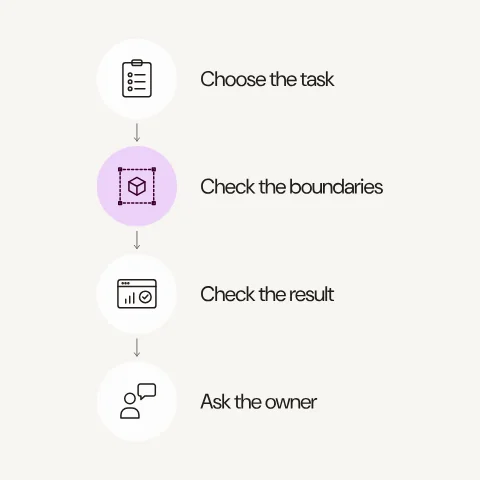
For an AI training program, the learning lead and the relevant business owner should first agree on the problem they are trying to address. Avoid choosing a measure merely because the training system makes it easy to export.
Consider this hypothetical example, not a customer result or a framework-prescribed measure:
- Intended outcome: Reduce rework associated with unsupported factual claims in AI-assisted drafts.
- Critical behavior: The author checks factual claims using the sources required by the team’s editorial rules.
- Learning requirement: The author can identify a claim that needs verification and demonstrate the required check.
- Workplace support: Employees have access to suitable sources, clear review instructions, and a named person to ask for help.
- Possible evidence: Existing editorial review records, if they capture the relevant checks and rework.
Whether this example fits depends on your workflow and available evidence. A finance process or a customer-support workflow would need its own outcome, critical behavior, and assessment criteria.
Use Level 2 to assess what employees learned
Kirkpatrick Partners describes pre- and post-tests as traditional Level 2 methods and also identifies alternatives such as role plays and teachbacks. The method should fit what the employee needs to demonstrate.
An AI knowledge question can assess whether someone recognizes a rule. A practical demonstration can assess whether they can apply it in the assessment setting. Neither should be described as direct evidence of routine workplace behavior.
For example, an organization could use a fictional AI-generated draft and ask an employee to explain which claims require checking under its own policy. That is an illustrative assessment task, not an official Kirkpatrick AI-literacy test.
If you compare assessments before and after training, document the tasks and scoring criteria so readers can understand what changed. Do not describe a locally designed test as standardized or validated unless you have evidence supporting that description.
Confidence also belongs within Kirkpatrick’s Level 2 definition. Keep its interpretation clear: an employee reporting greater confidence is different from an employee demonstrating a skill.
Use Level 3 to examine workplace application
Level 3 is the central level for this article’s question. Kirkpatrick Partners defines it in terms of critical behaviors performed in the work environment, supported by accountability and performance support.
Its guidance gives manager check-ins, observations, and job aids as examples of support and accountability. The relevant question is therefore broader than whether an employee remembers the course: can they apply the behavior, and does their environment help them do so?
Select evidence that matches the behavior
The following are illustrative applications, not a mandatory checklist or a published AI measurement standard:
| Illustrative behavior | Possible workplace evidence | Context needed to interpret it |
|---|---|---|
| An author performs a required factual check | An approved review record showing the check | Which claims required checking and which sources were acceptable |
| An employee seeks approval for an unfamiliar use | A documented request through the designated process | Whether that use actually required approval |
| An employee follows a restriction on information entry | An authorized review of the relevant work process | The applicable information-handling rule and permitted evidence access |
| A reviewer applies a required human-review step | A workflow record showing the review | Which tasks required review and who could approve them |
Use only evidence you are authorized to collect and review. Agree on appropriate access and handling with the responsible privacy, legal, and employee-governance teams before introducing employee-level monitoring.
Check support as well as performance
When the expected behavior is missing, examine the surrounding conditions. Kirkpatrick Partners explicitly includes the performance environment in its current model and describes leadership, systems, and culture as influences on results.
In an AI workflow, relevant questions could include whether the approved tool is available, whether the policy answers the actual question, and whether the manager allows time for the required review. These are applications of the framework’s workplace-environment principle, not a separate AI standard.
The finding should guide the response. A missing skill points toward instruction or practice; an inaccessible approval route points toward a workflow problem.
When should you assess behavior change?
The source does not prescribe a universal follow-up calendar for AI literacy training. Kirkpatrick Partners warns against waiting until 90 days after learning to begin measuring behavior because that can delay support and course correction.
Plan observation around when employees have a relevant opportunity to use the learning. Identify that opportunity and the person responsible for follow-up before launching the program. Do not present a locally chosen interval as a recognized standard.
Distinguish an observed failure to apply a rule from a lack of opportunity to observe it. If an employee has not encountered the relevant task, the available evidence cannot establish how they would perform it in practice.
Does improvement prove that training caused the change?
A change after training is not, by itself, proof that training caused it. Kirkpatrick Partners cautions that results are influenced by leadership, systems, culture, timing, and parallel initiatives.
Suppose training arrives alongside a clearer policy and a new approval workflow. A subsequent improvement should be interpreted in that context rather than attributed entirely to the course.
Describe the training’s contribution only as strongly as the evaluation design and evidence support. The Kirkpatrick levels organize evaluation questions; assigning a result to Level 4 does not automatically establish causation.
What should you report to executives?
Structure the report around the framework’s distinctions. State the intended organizational outcome, what employees learned, what workplace behavior was observed, and what support or barriers affected application.
Keep the evidence scope visible. Readers need to know whose work was reviewed, which tasks were included, and whether the findings represent a sample or the whole relevant population.
A useful report also distinguishes:
- Source-based definitions: The Kirkpatrick levels and their purpose.
- Local evaluation choices: Your selected behaviors, evidence sources, and review timing.
- Observed findings: What the collected evidence actually shows.
- Limits and next actions: What remains uncertain and who will address it.
Do not turn a locally designed scorecard into a claim of external certification. A framework provides structure; the quality and limits of the underlying evidence still matter.
FAQ
Which recognized framework can evaluate AI literacy training?
The Kirkpatrick Model can structure evaluation through Reaction, Learning, Behavior, and Results. It is a general training-evaluation framework, not an AI-specific certification standard.
Which Kirkpatrick level measures behavior change?
Level 3: Behavior evaluates whether people perform critical behaviors in their work environment, with support and accountability. For AI training, the relevant behaviors must be defined for the organization’s actual tasks and policies.
Do better test scores prove employees changed their workplace behavior?
Better assessment performance provides evidence about Level 2: Learning. Workplace application is a separate Level 3 question and requires evidence from the work environment.
Does Kirkpatrick prescribe AI-literacy pass marks or review intervals?
The cited Kirkpatrick guidance does not provide universal AI-literacy pass marks or a fixed follow-up calendar. It warns against waiting until 90 days after learning to begin measuring behavior.
Are verification and escalation official Kirkpatrick AI measures?
No. Verification and escalation are illustrative workplace applications in this article, not AI measures prescribed by Kirkpatrick Partners. Their relevance depends on the organization’s policy, tasks, and intended outcomes.
Can the Kirkpatrick Model prove training caused a business result?
The framework alone does not establish causation. Kirkpatrick Partners identifies leadership, systems, culture, timing, and parallel initiatives as factors that also influence organizational results.
Keep support within reach
The behavior question includes what the workplace enables, not just what employees know. If people understand the expected action but cannot access the approved tool, source, or reviewer, repeating the course does not address that barrier.
Evaluate application and its conditions together. That is the distinction that makes Level 3 useful for decisions about training, manager support, and the work process.
Source
Kirkpatrick Partners, The Kirkpatrick Model, consulted Oct. 27, 2026. The official model page supplies the evaluation-level definitions and guidance on results-first planning, performance support, the performance environment, and timing. AI-specific scenarios in this article are explicitly labeled applications, not quoted framework requirements.
On the model’s popularity and causal-chain evidence: Institute for Employment Studies, Kirkpatrick and Beyond: A Review of Models of Training Evaluation (2002), and a 2021 peer-reviewed review of the Kirkpatrick Model in higher education, consulted Oct. 27, 2026. Both are linked in the section on the model’s validation.