Building AI learning content is a constant balance between clarity and creativity. Push too little, and things get boring. Push too far, and you might end up surprising people in ways you didn’t intend. This is a short story about how we learned that lesson — thanks to a chicken.
You’re probably familiar with the situation where you’re so deep into your own product or process that you become a bit blind to it.
That’s something that can easily happen to us, especially when producing content for our AI courses. Here’s a recent example I’d like to share with you.
The chicken experiment
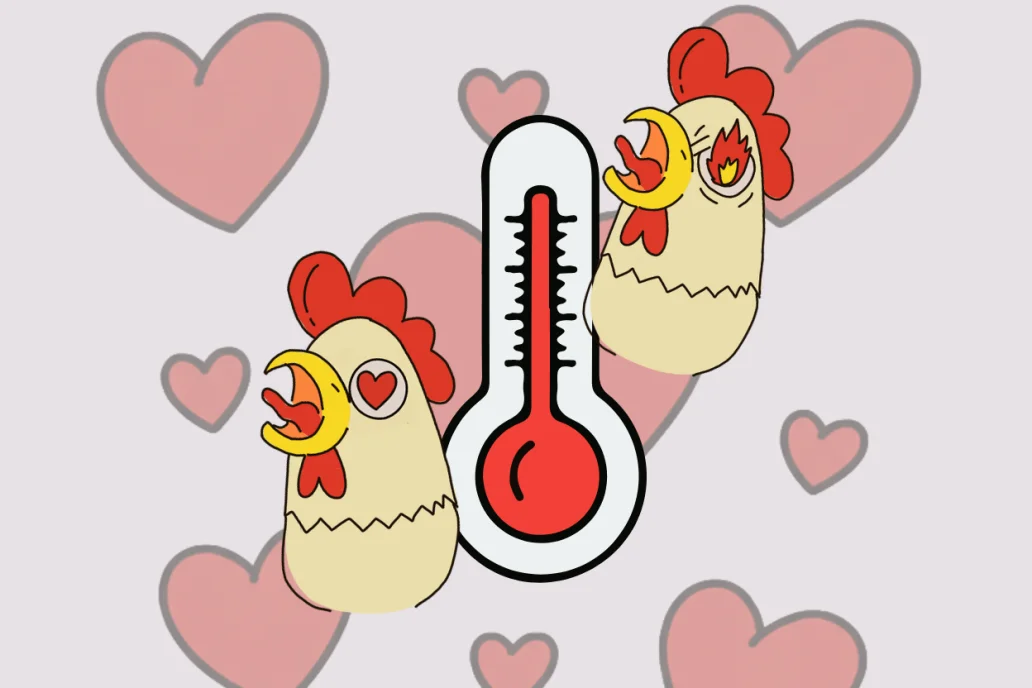
One feature of LLMs (large language models) is randomness. This simply means that if you ask an LLM the same question over and over again, the responses will vary. There’s something called temperature (in the sense of hot/cold) — a built-in setting in the model that controls the tone of its answers. In short, the lower the temperature (like 0), the more neutral the answer. The higher the temperature, the more variety and adventurousness you get in the responses.
(I would assume Grok has a pretty high temperature setting.)
This temperature feature is something we wanted to include in our Get AI Ready course content — not only in text, but also by making it more lively through an interactive illustration.
How would you illustrate a high temperature? Fire, obviously.
To make the concept relatable — and keep things a bit playful — we knew we needed a simple story to work with. So we went with the old classic: “Why did the chicken cross the road?” Me, David, and Benze started tossing ideas around, and the jokes quickly escalated. Fire came up. Then more fire. We didn’t go all the way down every rabbit hole, but the direction was clear. Out of that came a slider that shows three answers to the same question — low, medium, and high “temperature” — each with its own illustration.
The highest-temperature answer would then, quite clearly, show a chicken on fire.
So here’s how it turned out:
Genius, we thought. We proudly shipped the product to our piloting customers.
They had a valid point.
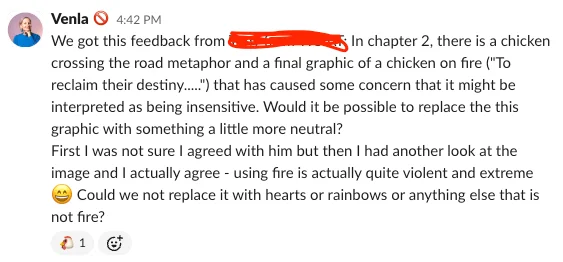
Indeed, a chicken with eyes on fire might be too much for some. And yet, we knew that catchy content needs a bit of edge – we shouldn’t compromise our vision and handprint too much.
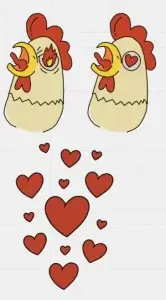
So we got back to the drawing board. We thought about what could be the smallest possible edit that would make the illustrations more accessible without taking it too far from the original idea. In the end, the chicken got to stay, but the fire needed to be distinguished.
We gave it hearts! ❤️❤️❤️
What we learned?
Always pilot and test before a wider launch
Have your customers close and let them openly give feedback on the product. This way, you don’t only make sure it meets their expectations, but you also give them a sense of ownership.
Don’t limit your imagination too early
We admit it, a flaming chicken went a bit far. But had we thought of every single aspect when making the first sketches, our interactions and illustrations would probably have ended up much more boring than they did.
If you have a need to raise AI literacy in your organization…
If this sparked your curiosity and you’re thinking about how AI literacy could look in your own organization, we run weekly info sessions where me and/or Ossi walk through what we’ve built and why.
You’re very welcome to join — just book a time and show up.