What does AI adoption look like at your company? Where do you even start? Should everyone learn to code? Should leaders focus on ethics? After working with global teams, we realized the answer isn’t a straight line—it’s a pyramid.
What is AI Literacy, anyway?
After hundreds of calls with organizations over the past 3 years, this struck: organizations struggle to build AI maturity because there’s no systematic way to structure learning in the first place. Some offer generic training; others throw tools at teams and hope for the best. But without a shared understanding of what AI literacy means (or what each role actually needs), progress might stall.
I also found out it’s hard to find common ground in building a shared understanding without some kind of visualization. We saw this firsthand with some Arabic-speaking clients. Communication only worked when we sat together and pointed at a shared visual, saying, “This is what we’re talking about.” Without that, even basic concepts got lost in translation.
We spent some time looking for that visualizations: we searched the internet and sat in webinars organized by the European Parliament. The problem was, they were overly complicated and hard to get a grasp of.
So, we created our own. And that’s what I’m sharing with you today.
The AI Literacy Pyramid: A Cross-Section of AI Literacy
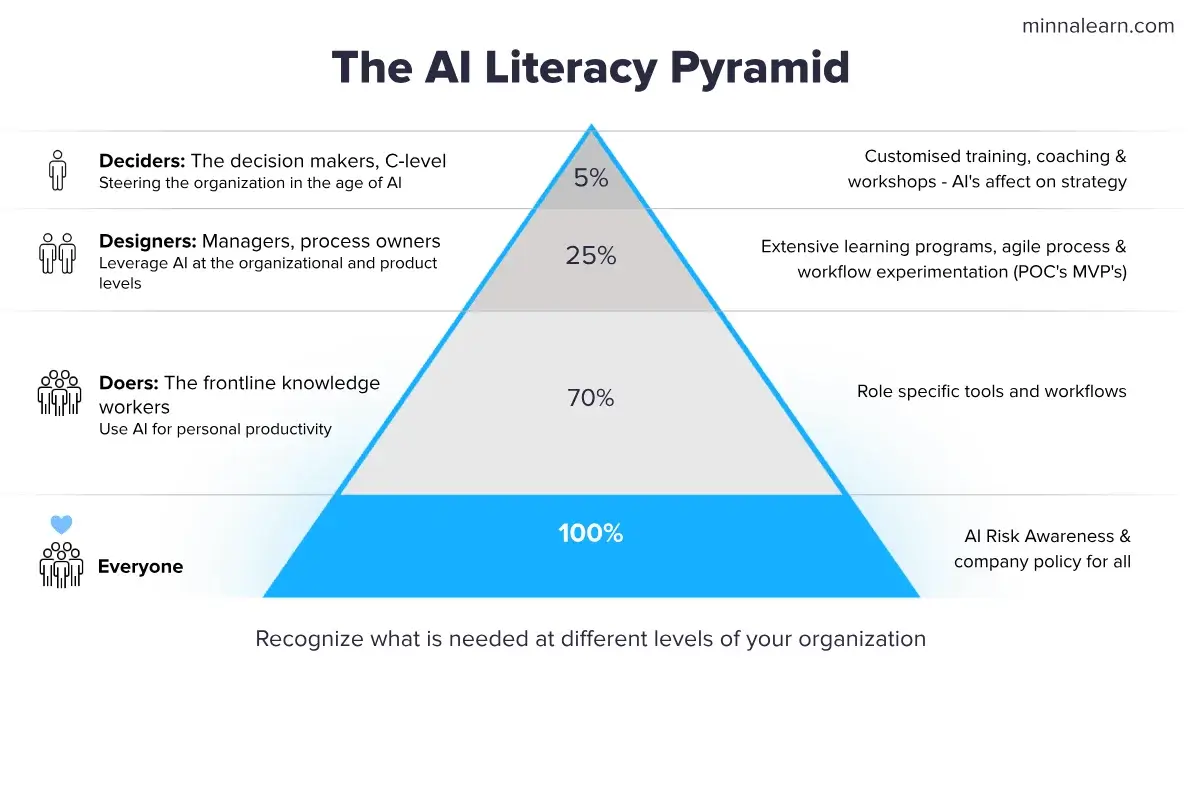
Something was needed to get the conversation flowing. We didn’t set out to create a scientific model. Instead, we built something intuitive, based on years of working with global teams. The result? A pyramid that reflects the average organization’s different levels of AI literacy.
Here’s how it breaks down:
- Doers (Base Level): Knowledge workers focused on personal productivity. They need to know how to use AI tools for their specific role — whether in sales, marketing, or production. Without this foundation, everything else becomes risky (inefficient use, security gaps, or even misuse).
- Designers (Mid Level): People who want to embed AI into products, services, or processes. They need deeper technical skills to turn AI’s exponential potential into reality.
- Deciders (Top Level): Leaders navigating strategic questions: How do we steer this organization in the AI era? What risks do we need to manage? What laws apply? They don’t need to code, but they do need to understand the implications.
Key Insight: The pyramid isn’t a ladder that workers climb as their skills increase, so the second step is not like a promotion. Rather, it’s a snapshot of an organization’s diverse needs at any given time. A salesperson might not need to build AI-driven processes, but they do need foundational literacy before diving into role-specific tools (like Copilot).
The Hard Truths
What’s next?
We’ve been refining this for three years, and it’s the best we’ve got… so far. Could it evolve into a 3D model? A maze? A cube? Maybe. For now, it’s a tool to start the right conversations.
Try it yourself
-
Download the AI Literacy Guide
- Gives recent insights into how AI is being used by workforce currently
- Breaks down what AI literacy actually means from the AI Act’s point of view
- Let’s you plan what kind of training do the people in different organization levels need
-
We go through the same things listed above but live – ask questions directly from me and my colleague Sampo
Any thoughts this provoked in you? I’m happy to chat (I do that all the time, actually) – just book a call with me (Ossi) here!